September 2018
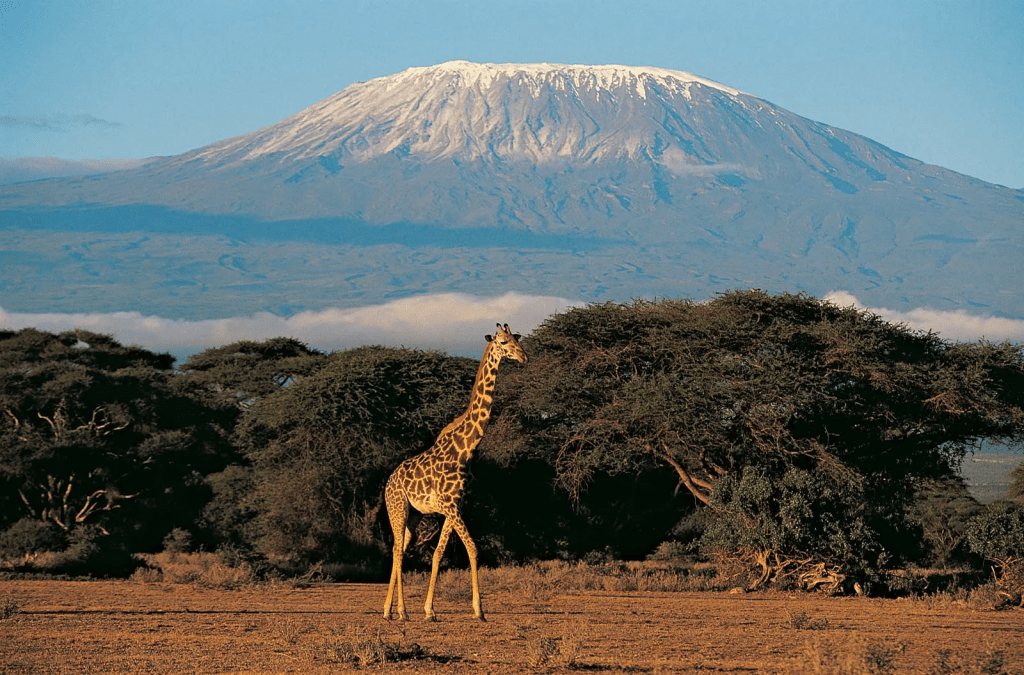
Arriving to Africa:
The trip of a lifetime had come. Not only would I have the opportunity to visit another continent, I’d get the chance to do the things I love there: hike, explore, and experience a different culture. After 3 different airports and 20 some-odd hours of being in the air, my dad and I finally landed at the Mt. Kilimanjaro airport (Arusha, Tanzania) around 8:00 PM. I was exhausted and didn’t fully fathom that we would begin our hike the very next day. Time was precious (especially for my PTO), and we wanted to get near the mountain as soon as possible to get acclimated and start our adventure. We were comforted by the third member of our crew, Larry, as he was a long-time family friend and had hiked Mt. Kilimanjaro 12 years prior.
When we met our driver just outside the airport, he stated that he was our driver, followed by something that completely threw me off: “You’re welcome.” My first reaction was this guy must have been salty that he had to drive us dumb Americans around, as we hadn’t even gotten the chance to say “Thank you” before he told us “You’re welcome.” He kept on saying it at random times during the 40-minute drive to our hotel, and finally around the third time, I figured out what he actually meant: “You are welcome [to Africa].” It was an expression of hospitality, that I had mistaken for something salty since Americans don’t generally say “You’re welcome” unless responding to “Thank you.” The reason I say this is to convey just one of the many expression barriers we’d come to get used to. On a broader scale, we had an entirely different world to get used to! I grew to love it. It took time to let go of what I was used to from American culture and let myself roll with the punches of African ways.
Of course, I wasn’t finding the silver lining in the moment. To the contrary, I looked out the window during our drive and suddenly found myself trying not to panic. I was nearly 10,000 miles away from home and didn’t know one person on this entire continent. Dialing 9-1-1 wouldn’t have even worked. It was so dark out I couldn’t see the terrain of the land, and only in the headlights of our van could I see people walking in the darkness of the dirt roads, some with baskets on their heads, going about their nightly business. It was a whole different world, and I couldn’t have been more nervous and excited. We finally arrived at our hotel where we got a hot shower and a nice bed – two things we wouldn’t have for the next 8 days.
Day 1 – Big Tree Camp or “Mti Mkubwa Camp” (9,255 ft elevation)
The next morning, we met our team of guides and porters that would be taking us up the mountain. For only 3 Americans (Larry, my dad, me), I expected we’d have 1 guide and maybe 3 or 4 porters to help lighten our load. No…not even close. We had 2 guides, and 13 porters! Like seriously, how pathetic did we look? No way would we need 15 Africans taking us up the mountain?! I rolled with the punches. They knew what they were doing, we didn’t. So, we got on the bus and drove towards the base of the mountain. Three hours later, we got off in the thick of the rainforest and began the hike. Not 2 minutes in, our guides say to us, “Pole pole,” which is Swahili for “Slowly slowly.” The pace of these guides was something that would make any athlete or runner go insane. Yet again, I tried my best to trust the guides and go their pace. We saw small monkeys jumping through the trees during the hike, but still couldn’t see the mountain in the density of the rainforest. After about 4 hours, we arrived at the first base camp, Big Tree Camp. A glance of this campsite told us that Mt. Kilimanjaro was one popular global destination. There were tents spread out as far as the eye could see, each tent owned by an expedition business. Our porters had already set up camp before we arrived, and to our amazement, they had set up a separate “mess hall” tent for us to eat our meals in. We even had our own waiter (who was also a porter), and we didn’t have to do any prep work or cleanup, ever…let’s just say I wasn’t exactly complaining.


Day 2 – Shira 1 Camp (11,844 ft)
After a hearty breakfast made by our cook, we continued our trek upwards, making our way out of the rainforest and getting a glimpse of the vast flatlands below us. We were now in a dusty terrain with thick brush surrounding us. It reminded me of the hiking terrain in San Diego and helped me feel not so far away. While we still couldn’t see Kilimanjaro, our guides pointed out another mountain that came into view behind us – Mt. Meru, the 5th tallest mountain in Africa about 43 miles west of Kilimanjaro. Even in the distance it towered above us, and I wondered what Kilimanjaro would look like in comparison. With no trees to block the wind anymore, we felt (and saw) the effects as dirt wafted around us and the temperature dropped quite dramatically. Then finally, during our last mile of the day, Kilimanjaro came into view. It wasn’t a menacing mountain, as most volcanoes are more rounded and broader than sharp and jagged. As I looked upon it, I reminded myself this was one of the seven summits, the tallest mountain in Africa, the reason I had traveled nearly 10,000 miles from home, and I was excited to see what challenges it had in store for us.

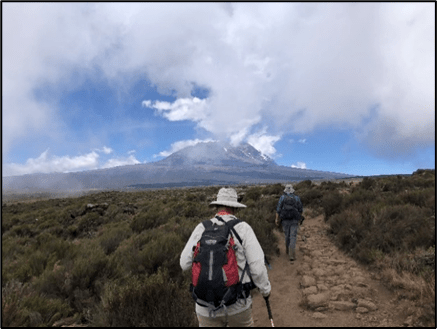
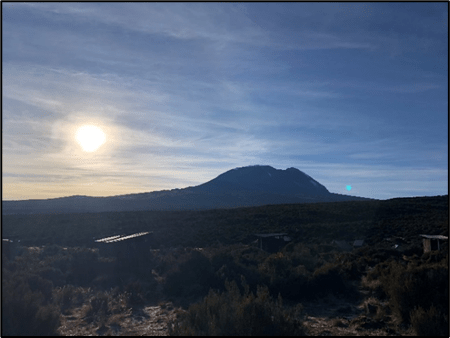
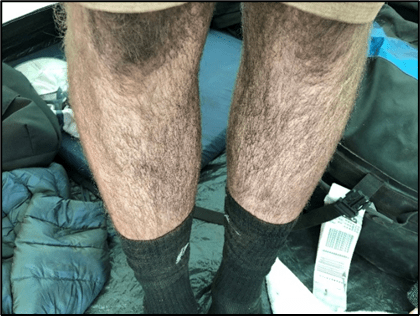
I’ve done a lot of hikes, but none had been as dusty and dirty as this one. The combination of high winds and dry, dusty conditions proved to be a strong reason for wearing long pants, I learned.
Day 3 – Moir Hut Camp (13,800 ft)
After our stay at Shira 1 Camp, we were expecting to head to Shira 2 Camp, which really wasn’t too far away. Our guides however told us a more recent alternate route had been put in place. This led us to a different camp called Moir Hut Camp at 13,800 feet elevation. While the hike to this camp was relatively short, we started to feel the effects of the thin air. During dinner our guides gave us our daily oxygen test, where we’d use a pulse oximeter to measure the oxygen saturation in our blood. To put this into perspective, hospitals in the U.S. don’t allow patients to leave unless their oxygen level is above 90%. As we passed the oximeter around, all our blood levels were in the 80’s, mine being 87% exactly. Our guides told us it was normal, and that only serious caution would need to be taken if levels dropped below 60%. This was a relief, but I also wondered how much farther my oxygen level would drop when we still had over 6,000 feet to gain in elevation! As a joke, we asked one of our guides to test his own oxygen level. He placed the oximeter on his finger and after a few seconds showed us his result: 99%.

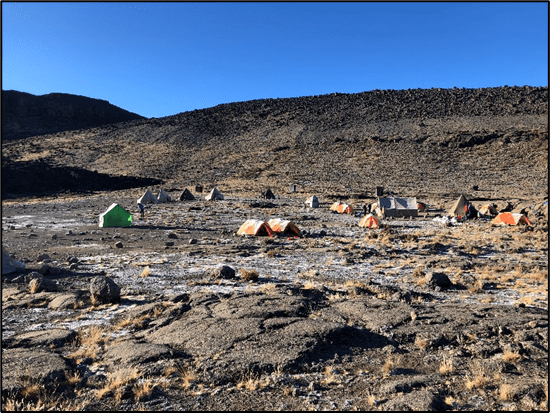
Day 4 – Baranco Camp (12,795 ft)
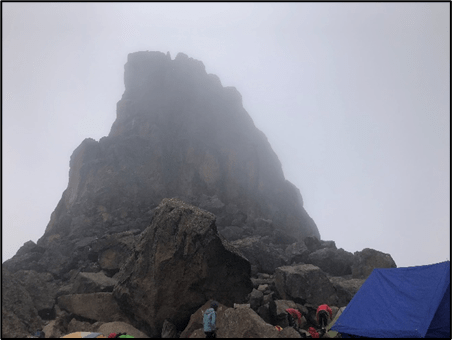
We were halfway to our goal now. As we continued on, our guides took us to the prestigious Lava Tower at 15,092 feet, where we stopped and had lunch. The Lava Tower is a giant 300-foot volcanic rock formation that stands out quite impressively on the edge of the path, but during this day it was so foggy we could barely see the top of the massive landmark. As we finished up lunch, we saw a very slight but sure snowfall, and for the very first time our guides urged us to move quickly. We had all the gear we needed for rain and snow, but ideally our guides thought it better to outpace the rain and get to camp sooner. I agreed wholeheartedly. From the Lava Tower we descended a whopping 2,000 feet into our next camp, which was much larger than our previous two campsites. Baranco Camp was where several routes collided and was a major camping ground for all parties taking different routes. Being on the west side of the mountain now, it was the first night that we saw the small twinkling lights from the village of Moshi far below us.

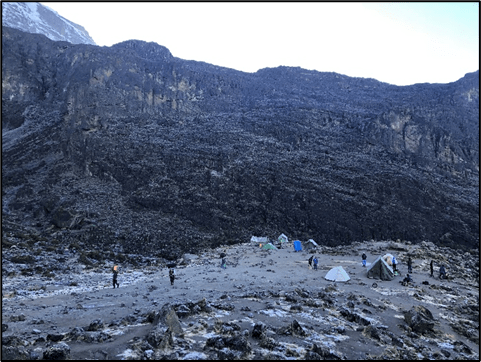
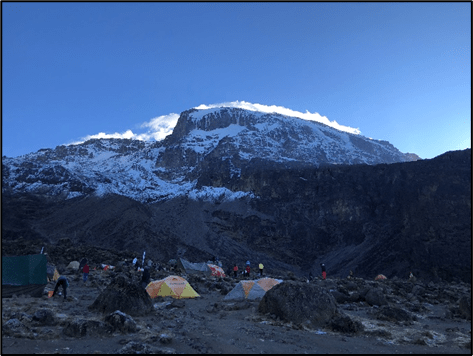
Starting to grow familiar with Kili as it looms over us.
Day 5 – Karanga Camp (13,107 ft)
Our next destination was Karanga Camp, but to get there we first needed to scale what was called the “Baranco Wall,” a massive 840-foot rock wall (right next to Baranco Camp). This proved to be quite the obstacle. There was no going around it, and only by squinting could we see the porters ascending it far above us. So far, the trail hadn’t been technical and no scrambling was required during any stretch. This was different. This was the challenge I was looking for; I wanted to feel like I had earned my way up this mountain, that it wasn’t something a child could do (although many children have done it, the youngest ever at 7 years old). There were definitely areas of this wall where we had to use all four limbs to continue; we saw one porter drop his bag off a small ledge, where gravity gave it momentum to continue falling about 100 feet farther down. With no visible signs of complaint, he simply scrambled down and retrieved the bag, put it back on his head, and scrambled back up where he left off. In reality this wall was probably a small speedbump for most of these porters who seemed like natural rock climbers. In any case, when we reached Karanga Camp, we realized this would be our last full night of sleep, as the next night would be when we got up at 12 AM to start the final ascent.
Day 6 – Barafu Camp (15,331 ft)
The day hike to Barafu Camp was the shortest of all the days, but not necessarily the easiest. In 1.1 miles, we gained over 2,000 feet in elevation, putting us at 15,331 feet elevation the final night before the summit. Everything seemed harder to do at this elevation due to the thin air; just getting in and out of the tent took some effort. The clouds rolled in surrounding us in the afternoon, and as we ate dinner around 6:00, our guides came into our mess hall tent with a significantly more serious tone than in previous nights. They explained what the schedule would look like for the next day, and emphasized the importance of turning back should any kind of emergency occur. The guides depended on their clients’ summitting success for high ratings, but the last thing they wanted was a client who had to be evacuated off the mountain. We took one last oxygen test, and as I got into the tent I noted how much windier it was than in any of the previous camps. I had no idea what was in store the next few hours.
Day 7 – The Summit (19,341 ft)
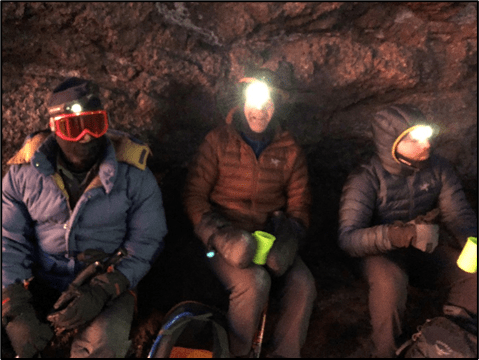
We woke up at the scheduled time of 12 AM to make the final ascent. For some reason, I immediately thought about life back home, where it was 2:00 PM on a Sunday: everyone enjoying their weekend, relaxing, maybe watching football, while I was up at midnight, in Tanzania, about to hike into sub-0 temperatures with more wind chill than I’d ever experienced. Headlamps on, we departed, and honestly I didn’t feel too cold at first (I was wearing three layers, all warm clothes with one down jacket, along with thick gloves and a balaclava). Every few minutes I’d look up and see small twinkling lights produced from other headlamps. The stars were out, but there was no moonlight to see even the outline of the mountain. We were hiking blindly, depending entirely on our guides to get us to the summit. Around 12:45 AM, the wind started really picking up, and it got colder. Much colder. Not like, “Wow I wish I had another jacket” cold, but like “I don’t think I can keep walking” cold. I started shivering and stuffed my gloved hands in my jacket pockets while extending my lower teeth out so I could breathe warm air into my face. My nose started running like crazy and for the first time during the trip I started having doubts on whether I could do this. To make matters worse, we saw several hikers being escorted back down the narrow pathway, their guides holding them carefully making sure they didn’t collapse or pass out. Candy wrappers and other trash scattered the trail, as littering was no longer a concern for anyone trying to survive the next step (I saw this because I was looking down a lot).
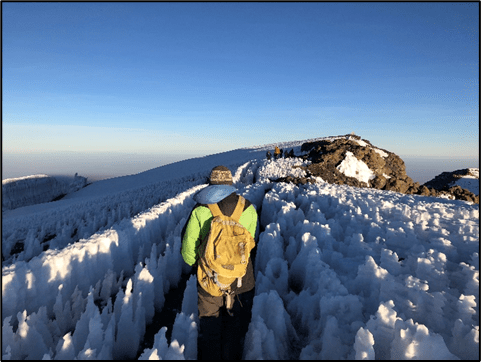
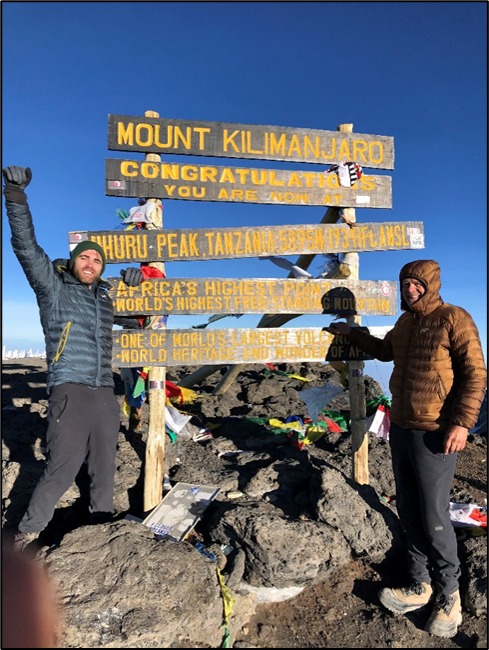
At 2:15 AM, we stopped for a water break. I overheard Larry ask one of our guides, “How far are we from Stella Point?” to which our guide responded “You don’t want to know. Ask me around 5 AM.” Stella Point was located on the crest of the volcano’s caldera; once you made it there, it was only about 30 more minutes to the summit. My mind continued to race for motivational thoughts, anything to keep my feet going. As a runner, this was something I was familiar with; it’s always been so fascinating to me how mental a lot of things are. (As a big Lord of the Rings nerd, I of course thought of the Mt. Doom scene where Sam and Frodo are struggling to continue. I tried channeling Sam’s motivational speech, and then realized I just wanted him to carry me up this mountain like he did for Frodo. LOL). We continued onward and finally reached Stella Point at 18,638 feet, where we saw the vastness of the volcano’s caldera. At this point we started seeing rays of sunlight come up over the horizon, and since Stella Point is basically 30 minutes from the summit, we felt relief in knowing we didn’t have much further to go. At exactly 7:00 AM, we reached the summit of Kilimanjaro, and with the sun now up in full, it didn’t feel quite as cold, but it could’ve been the success of making it that warmed the air. As I looked around I spotted Mt. Meru – it looked like a small hill from up there! It was surreal and something I’ll never forget. We had reached “the roof of Africa” as our guides told us, and it’ll be a lasting memory I’ll have with my dad.
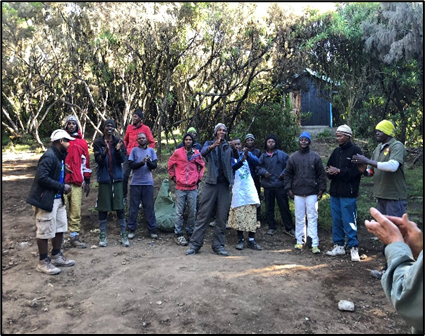
Our entire crew of guides and porters that made it possible (and WAY easier) to accomplish this.
 The Adventure Chronicles
Leave a comment